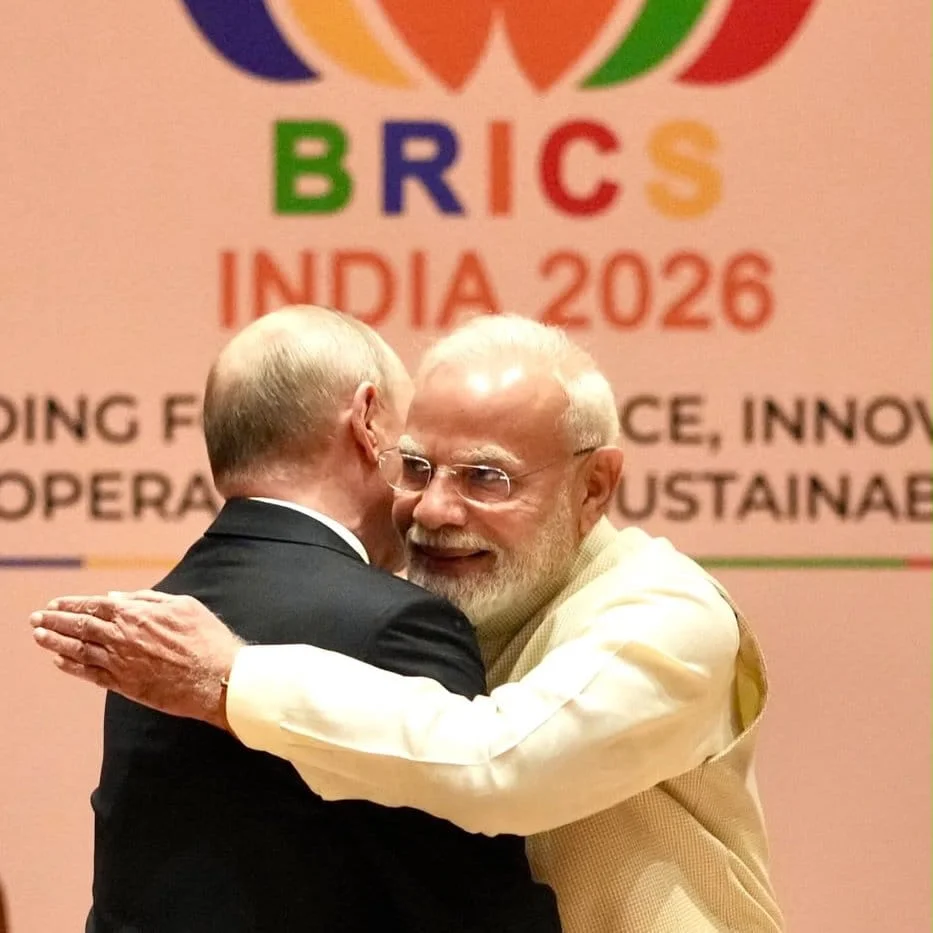
On Friday, September 11, 2026, Russian President Vladimir Putin stepped onto the tarmac in the Indian capital. He arrived with a powerful delegation of energy ministers, banking chiefs, and defense officials for the 18th BRICS Summit at Bharat Mandapam.
In Western capitals, President Putin faces sweeping economic sanctions and an International Criminal Court warrant. But in New Delhi, he received a warm red-carpet welcome from Prime Minister Narendra Modi. India is not a member of the International Criminal Court, meaning the Russian president has full diplomatic immunity on Indian soil.
Behind the formal handshakes lies a hard economic reality: energy security.
Over the last four years, discounted Russian crude oil quietly protected 1.4 billion Indians from a global inflation crisis. Today, that emergency trade has turned into a permanent economic alliance.
What does this crucial meeting mean for everyday fuel prices? How will India and Russia bypass Western financial curbs? And can New Delhi keep buying Russian oil without hurting its friendship with the West?
As Russian President Vladimir Putin arrives in New Delhi for the 18th BRICS Summit, the spotlight is firmly on the future of India Russia energy ties
Quick Summary: What You Need to Know in 60 Seconds
-
The Historic Arrival: On September 11, 2026, Russian President Vladimir Putin arrived in New Delhi for the 18th BRICS Summit. Consequently, this marks his first in-person trip to an overseas BRICS summit since 2022.
-
The Energy Lifeline: In fact, Russia has become India’s primary supplier of crude oil, providing nearly 40% of its total imports. Therefore, bilateral talks focus heavily on long-term oil supply deals and expanding the Kudankulam nuclear plant.
-
Overcoming Sanctions: Because Western sanctions cut Russian banks off from SWIFT, both countries are building local currency clearing systems. Furthermore, they are developing new maritime sea lanes to speed up cargo shipments.
-
The Agriculture Link: In addition to fuel, Russia supplies over a quarter of India’s chemical fertilizers. As a result, this partnership directly protects Indian farmers from global price spikes.
-
The Diplomatic Balance: Meanwhile, Prime Minister Narendra Modi is firmly defending India’s energy rights while actively preserving close technology partnerships with the United States and Europe.
Why Did Putin’s Arrival in New Delhi Capture Global Attention?
On Friday, September 11, 2026, Russian President Vladimir Putin touched down in the Indian capital. He arrived with a senior delegation of energy ministers and trade officials for the 18th BRICS Summit at Bharat Mandapam.
In Western capitals, President Putin faces sweeping economic sanctions and an arrest warrant from the International Criminal Court. In contrast, he received a formal red-carpet welcome in New Delhi from Prime Minister Narendra Modi. Because India never signed the Rome Statute of the ICC, the Russian leader enjoys full diplomatic immunity on Indian soil.
However, this visit is about much more than ceremonial handshakes. At its core, the meeting is driven by India’s national energy security.
Over the past four years, deeply discounted Russian crude oil helped protect 1.4 billion Indians from a global inflation crisis. Today, that emergency trade has turned into a permanent economic alliance.
Consequently, observers want to know what this meeting means for domestic fuel prices and international diplomacy. Below is a comprehensive breakdown of the negotiations happening behind closed doors.
What Does Putin’s Personal Visit Signal to the World?
According to live reporting from The Hindu, President Putin is holding extensive bilateral talks with Prime Minister Modi alongside the main BRICS agenda.
To begin with, this visit shatters the Western goal of isolating Moscow. Western leaders hoped sanctions would turn Russia into an economic outcast. However, President Putin sitting in New Delhi alongside PM Modi and Chinese President Xi Jinping proves that non-Western powers will not cut ties.
Furthermore, the visit demonstrates India’s independent foreign policy. New Delhi chooses its partners based on domestic economic survival rather than foreign pressure. Therefore, while India cooperates with the United States in the Quad to safeguard maritime security, it refuses to compromise its historical partnership with Russia.
How Did Russia Become India’s Primary Oil Supplier?
Before 2022, Russia supplied less than 2% of India’s total crude oil. During that period, India relied almost entirely on Middle Eastern producers like Iraq and Saudi Arabia.
However, that dynamic changed overnight. When European buyers stopped purchasing Russian crude, Moscow offered steep price discounts on its Urals oil. As a result, Indian state and private refiners stepped in to purchase millions of barrels every month.
Today, Russia supplies almost 40% of all crude oil entering Indian ports. This rapid trade expansion saved India an estimated $10 to $15 billion in import bills. Because of these cost savings, domestic petrol and diesel prices remained stable while other major economies battled severe fuel inflation.
How Do Indian Refineries Process and Re-Export Russian Oil?
Advanced refineries across India quickly adapted to process heavy Russian crude. For example, large complexes in Gujarat (Jamnagar and Vadinar) and Odisha (Paradip) refined discounted oil into diesel and jet fuel.
Subsequently, some of this refined fuel was exported back to international markets. As a result, India earned valuable foreign exchange while helping keep the global oil market balanced.
During the New Delhi summit, both governments are working to finalize long-term supply pacts. Specifically, Indian refiners want to replace spot purchases with guaranteed 3- to 5-year contracts to lock in stable pricing formulas for the future.
What Is Next for the Kudankulam Nuclear Power Plant?
Beyond fossil fuels, civil nuclear energy remains a central pillar of India-Russia cooperation.
Specifically, the Kudankulam Nuclear Power Plant in Tamil Nadu represents India’s largest nuclear project. Built with direct technical and financial support from Russia’s state atomic agency, Rosatom, the facility is expanding rapidly:
-
Units 1 and 2 are already running and generating clean baseload electricity for southern states.
-
Units 3, 4, 5, and 6 are currently under active construction.
In addition, bilateral talks in New Delhi are finalizing the site for a second Russian-designed nuclear park. This proposed facility will house six brand-new 1,200-megawatt reactors, significantly boosting India’s green energy capacity.
How Are Both Nations Exploring Small Modular Nuclear Reactors?
At the same time, Indian industries need steady, round-the-clock electricity without burning coal. To solve this challenge, both governments are discussing the joint development of Small Modular Reactors (SMRs).
Because these compact reactors can be built inside factories and shipped on trucks, they can be placed directly next to steel plants and manufacturing hubs. Consequently, SMRs offer a fast, emission-free power alternative for heavy industry.
Furthermore, India is expanding its investments in Russian natural gas. State-owned firms like ONGC Videsh already hold stakes in the Sakhalin-1 oil and gas fields. Now, Indian officials are negotiating long-term Liquefied Natural Gas (LNG) supplies from Russia’s Arctic projects to support city gas distribution networks.
How Do India and Russia Trade Without Using US Dollars?
The biggest hurdle facing bilateral trade is the international payment bottleneck.
Because Western sanctions disconnected major Russian banks from SWIFT and restricted transactions in US dollars, both nations had to engineer new financial rails.
First, banks established Special Rupee Vostro Accounts (SRVA). Under this arrangement, Indian importers deposit rupees directly into designated accounts to pay for oil. Russian exporters then use those accumulated rupees to purchase Indian manufactured goods and food products.
In addition, both sides are settling payments using neutral alternative currencies, including the UAE Dirham. Ultimately, this multi-currency system keeps oil tankers moving without triggering Western banking penalties.
How Are Leaders Resolving the “Rupee Trap” Challenge?
Early in the oil boom, a major financial imbalance emerged. Because Russia sells vastly more oil to India than it buys in return, Russian companies accumulated billions of surplus rupees in Indian banks.
However, the Delhi summit is rolling out a practical solution to this “rupee trap.”
Specifically, the Reserve Bank of India and Russian authorities have created rules that allow Russian energy companies to reinvest their surplus rupees directly into the Indian economy. For instance, these funds are now being directed into Indian corporate bonds, green energy projects, and domestic manufacturing ventures.
Moreover, technical teams are working to link India’s RuPay card network with Russia’s Mir payment system. As a result, tourists and business travelers will soon be able to make instant digital payments across both borders.
How Will New Sea Lanes Cut Shipping Times?
Currently, most Russian oil tankers take long, indirect routes through European waters to reach Indian ports. These voyages often take up to 40 days and face maritime bottlenecks.
Therefore, the New Delhi talks are accelerating work on two vital transit routes:
The Chennai–Vladivostok Maritime Corridor
This sea route connects India’s eastern coast directly to Russia’s Far East. As a result, shipping times drop from 40 days down to roughly 24 days. Furthermore, it cuts total travel distance by nearly 40% while avoiding narrow European chokepoints.
The International North-South Transport Corridor (INSTC)
Meanwhile, the INSTC uses a combined network of rail, road, and ship routes. It runs through Iran’s Chabahar port and the Caspian Sea into central Russia. Consequently, this corridor creates a safe inland trade route that bypasses Western-controlled waterways entirely.
Why Is Chemical Fertilizer Just as Critical as Crude Oil?
While crude oil attracts the most attention, chemical fertilizer is equally essential for India’s economic stability.
India has more than 140 million farming families. To grow staples like wheat, rice, and pulses, Indian agriculture depends heavily on chemical nutrients like urea, di-ammonium phosphate (DAP), and potash.
In fact, Russia supplies more than 25% of India’s total fertilizer imports. During recent global shortages, Moscow stepped in with discounted, guaranteed deliveries. Therefore, during the Delhi meetings, both nations are renewing long-term supply pacts to ensure Indian farmers receive reliable fertilizers at stable prices.
What Is the Status of Military and Defense Cooperation?
Approximately 60% of the Indian military’s inventory consists of Russian or Soviet-origin equipment. Therefore, while India is buying more defense hardware from France and the United States, Russia remains an indispensable defense partner.
As reported by Hindustan Times, defense talks in Delhi center on three key priorities:
-
Completing S-400 Deliveries: India has already deployed three squadrons of the advanced S-400 air defense missile system along its borders. Officials are now finalizing delivery schedules for the remaining two squadrons, which faced delays due to the Ukraine war.
-
Expanding ‘Make in India’ Defense: Both countries are expanding domestic manufacturing inside India. For example, a joint facility in Korwa, Uttar Pradesh, is actively producing AK-203 assault rifles for the Indian Army.
-
Manufacturing Jet and Tank Spares: Instead of importing replacement parts from Moscow, Russian defense firms are partnering with Indian engineering companies to manufacture spare parts for Su-30MKI fighter jets and T-90 tanks directly on Indian soil.
Comparing India-Russia Ties: Past vs. Present
| Strategic Sector | Pre-2022 Situation | Current Reality (2026) | Strategic Goal at Delhi Summit |
| Crude Oil Share | Under 2% of total imports | ~38% to 40% (Top supplier) | Lock in guaranteed 5-year supply contracts |
| Bilateral Trade | ~$10 to $12 Billion annually | Over $65 Billion annually | Target $100 Billion by 2030 with balanced trade |
| Payment Method | US Dollar and Euro | Rupee Vostro and Dirham rails | Complete integration of RuPay and Mir systems |
| Trade Corridors | Standard European sea routes | Red Sea route with bottlenecks | Operationalize the Chennai–Vladivostok sea lane |
| Nuclear Energy | Kudankulam Units 1 & 2 active | Units 3–6 under construction | Finalize land approval for a 2nd nuclear park |
| Defense Model | Direct buyer-and-seller model | Joint production inside India | Manufacture spares locally for tanks and jets |
How Does India Balance Russia with Its Western Partnerships?
Naturally, India’s close relationship with President Putin raises eyebrows in Washington and European capitals. However, Indian diplomats consistently defend this policy using three clear arguments:
-
Energy Security Is Non-Negotiable: India is a developing country with a per-capita income under $3,000. Therefore, affordable energy is necessary to power irrigation pumps, run small businesses, and control food inflation.
-
Preventing Global Market Chaos: In addition, Indian officials remind Western leaders that if India stopped buying Russian oil, world oil prices would quickly surge past $120 a barrel, hurting Western consumers as well.
-
Preserving Strategic Autonomy: Ultimately, India avoids joining rigid military alliances. Instead, it works with Western democracies in the Quad to protect the Indo-Pacific, while maintaining historical ties that protect its energy supplies and northern borders.
What to Watch for in the Coming Months
As the summit at Bharat Mandapam concludes, four major milestones will reveal the practical success of these talks:
-
Official Oil Contracts: Multi-year crude supply pacts signed between Indian state refiners and Russian energy producers.
-
Nuclear Site Selection: The official state announcement identifying the site for India’s second major Russian-designed nuclear power station.
-
Reinvestment Milestones: New regulatory approvals enabling Russian firms to channel surplus rupee balances into Indian corporate bonds and infrastructure.
-
Corridor Operationalization: The launch of regular commercial container runs along the Chennai–Vladivostok maritime corridor.
Frequently Asked Questions
Why is President Putin not arrested during his visit to India?
Although the International Criminal Court (ICC) issued an arrest warrant for President Putin in 2023, India is not a member of the ICC. Because India never signed the Rome Statute, it has no legal obligation to enforce the court’s warrants and extends full diplomatic immunity to visiting heads of state.
Why does India import such large amounts of Russian crude oil?
When European nations stopped purchasing Russian energy, Moscow offered heavy discounts on its crude oil. Consequently, buying discounted oil allowed India to save billions of dollars, keep retail petrol prices stable, and control domestic inflation.
What is the Kudankulam Nuclear Power Plant?
Kudankulam is India’s largest nuclear power installation, located in the Tirunelveli district of Tamil Nadu. It is being built in close technical partnership with Russia’s Rosatom. Two units are already generating power, while four additional units are under active construction.
How do India and Russia trade without using US dollars?
Both countries trade using national and alternative currencies. Specifically, they use Special Rupee Vostro Accounts in Indian banks and settle international invoices using currencies like the UAE Dirham, completely bypassing the Western SWIFT banking system.

Navya writes on global politics, foreign policy, and international relations. A Political Science graduate from Miranda House, she went on to complete her master’s degree at Delhi University. She focuses on breaking down complex geopolitical shifts and global events into clear, insightful explainers.
1 thought on “Fuel, Defiance, and Diplomacy: What Putin’s Visit to New Delhi Means for India’s Energy Future”